Globtim.jl Documentation


Global optimization of continuous functions via polynomial approximation
The Problem
Finding all local minima of a continuous function over a bounded domain is fundamentally hard. Standard optimization algorithms (gradient descent, BFGS, etc.) find one local minimum from a given starting point — but how do you know there isn't a better one elsewhere?
The Approach
Globtim solves this by replacing your function with a polynomial approximation. Why polynomials?
- Smooth functions are well-approximated by polynomials — Chebyshev and Legendre bases provide well-conditioned polynomial approximations whose accuracy improves with degree for smooth functions
- Polynomial critical points can be enumerated — Setting ∇p(x) = 0 gives a polynomial system with finitely many solutions (bounded by Bezout's theorem), which can be computed numerically via homotopy continuation or exactly via symbolic methods
- Refinement on the original function — Each polynomial critical point seeds a local optimization (BFGS) on the original function, which can converge to a nearby true critical point
The result: a systematic search for local minima across the entire domain, not just the nearest one.
The method comes with a global-capture guarantee: for Morse functions on a compact domain, the returned points provably contain and separate every local minimizer at the target precision (with high probability), under an explicit degree/sample/noise trade-off. This is established in the foundational paper — see Citation.
Algorithm Overview
f(x)  -->  Polynomial p(x)  -->  Solve grad(p) = 0  -->  Refine with BFGS  -->  Candidate minima
           (Chebyshev/Legendre)   (HomotopyContinuation.jl)
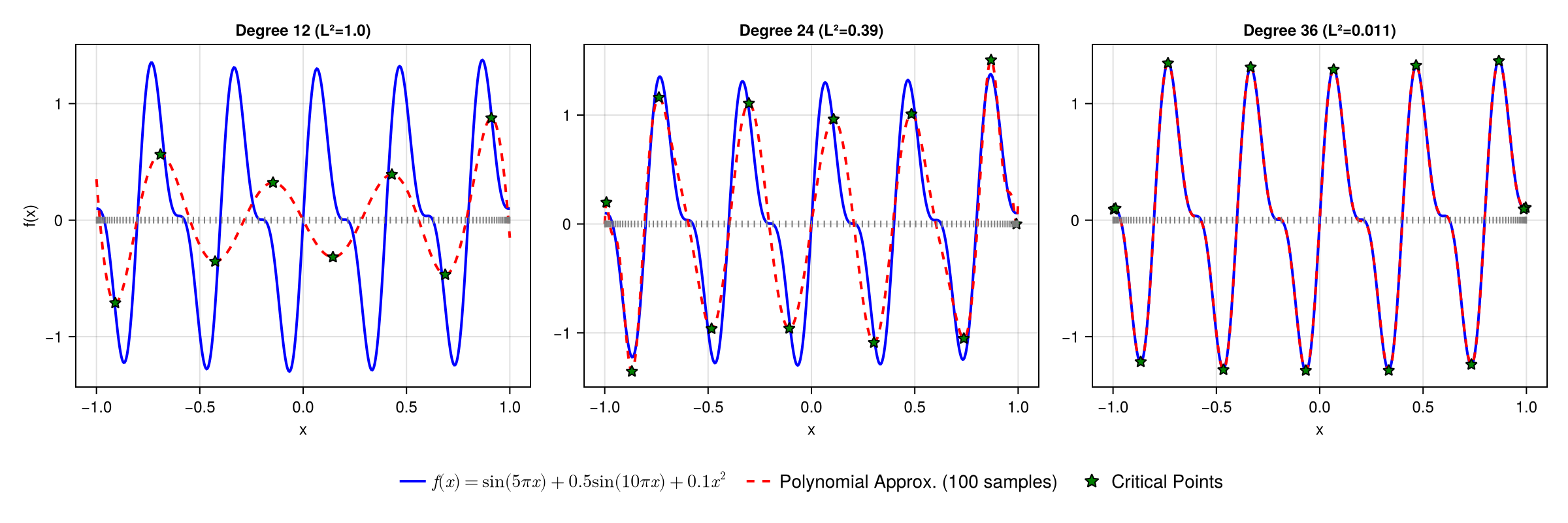
Challenging 1D function — multi-frequency oscillations at varying polynomial degrees:
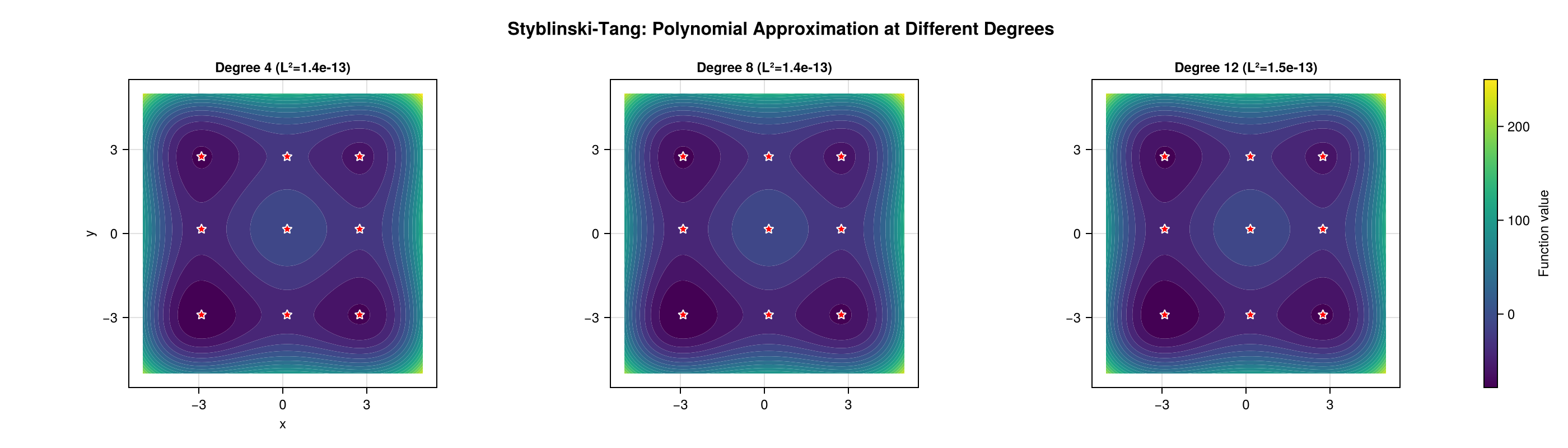
Styblinski-Tang 2D — classic test function with polynomial approximation:
For functions that vary on different scales in different regions, Globtim uses adaptive subdivision to build piecewise polynomial approximations that maintain accuracy everywhere.
Installation
Requires Julia 1.12 or newer. Press ] at the Julia prompt to enter Pkg mode (backspace exits):
julia> ]
pkg> add Globtim HomotopyContinuation
HomotopyContinuation is a weak dependency loaded through a package extension, so it installs separately. The default :hc solver stays unavailable until you using HomotopyContinuation alongside Globtim — install it unless you plan to use msolve instead.
Additional Dependencies
- Visualization:
add CairoMakieoradd GLMakie - Exact solving: Install msolve (symbolic method based on Groebner basis computations)
Getting Started
For a detailed walkthrough, see Getting Started.
Ecosystem
Globtim is the core of a family of packages spanning objective generation, optimization, analysis, and visualization. Each package's documentation lives in its repository (README + docs/); rendered documentation sites are being rolled out as the companion packages are registered.
| Package | Role | Documentation |
|---|---|---|
| Globtim | Core: polynomial approximation + all-critical-point finding | you are here — repo |
| DynamicObjectives | ODE-based objective functions + model catalogue (inputs to Globtim) | repo & docs |
| GlobtimPostProcessing | Refinement, validation, parameter recovery, campaign analysis | repo & docs |
| GlobtimPlots | Visualization (CairoMakie / GLMakie / WGLMakie) | repo & docs |
DynamicObjectives (objectives) --> Globtim (optimize) --> GlobtimPostProcessing (analyze) --> GlobtimPlots (visualize)See the Ecosystem Walkthrough for one objective carried end-to-end across the family. GlobtimPostProcessing is registered; GlobtimPlots and DynamicObjectives install from their repositories until they are:
pkg> add GlobtimPostProcessing
pkg> add https://github.com/gescholt/GlobtimPlots.jl
pkg> add https://github.com/gescholt/DynamicObjectives.jl
Citation
Globtim implements the algorithm introduced in:
Safey El Din, M., Scholten, G., & Trélat, E. (2026). Probabilistic algorithm for computing all local minimizers of Morse functions on a compact domain. Mathematics of Control, Signals, and Systems. doi:10.1007/s00498-026-00441-3. Free access: HAL hal-05160251.
If you use Globtim in your research, please cite this paper:
@article{safeyeldin2026probabilistic,
  author  = {Safey El Din, Mohab and Scholten, Georgy and Tr{\'e}lat, Emmanuel},
  title   = {Probabilistic algorithm for computing all local minimizers of {Morse} functions on a compact domain},
  journal = {Mathematics of Control, Signals, and Systems},
  year    = {2026},
  doi     = {10.1007/s00498-026-00441-3},
  note    = {Free access: HAL hal-05160251, https://hal.sorbonne-universite.fr/hal-05160251v2},
}